
Key values
Source: compilation of the IEC 60079-20-1:2010 data table and GESTIS (IFA, October 2026); the conservative end of the range (lowest LEL, flash point and AIT, highest UEL); gas group from GESTIS.
Explosive range and ppm values
Carbon monoxide can ignite when mixed with air between 10.9 % and 76 % by volume. Below the LEL the mixture is too lean to ignite, above the UEL too rich. A rich mixture re-enters the range when it is diluted with air, so concentrations above the upper limit are not safe either.
The lower explosive limit in ppm and g/m³. Useful to compare a gas detector's %LEL reading with ppm values in a measurement report.
| Concentration | ppm | g/m³ (20 °C) |
|---|---|---|
| 1 LEL (100 %LEL) | 109,000 | 126.9 |
| 20 %LEL | 21,800 | 25.38 |
| 10 %LEL | 10,900 | 12.69 |
Lighter or heavier than air?
Carbon monoxide is slightly lighter than air: relative density 0.97 (air = 1). A release tends to rise, but as its density is close to that of air it mixes readily with air movement and spreads around.
The relative density applies to the substance at room temperature. Very cold releases, for example from an evaporating liquefied gas, can behave as heavier than air for a while.
Ex equipment selection
Autoignition temperature 605 °C. The maximum surface temperature of equipment in the zone must stay below it: all temperature classes (T1–T6) are suitable.
- T1450 °C suitable
- T2300 °C suitable
- T3200 °C suitable
- T4135 °C suitable
- T5100 °C suitable
- T685 °C suitable
- IIA suitable
- IIB suitable
- IIC suitable
Gas group IIA: equipment marked IIA, IIB or IIC may be used. The equipment protection level (EPL: Ga, Gb, Gc) depends on the zone, not on the substance; the zone is decided in the explosion protection document from the release and the ventilation. Specific conditions in the certificate (X) and the ambient temperature range are checked separately.
Where is it found?
A product of incomplete combustion; found in blast furnace and coke oven gas in steelworks and foundries, in gasification plants and in synthesis gas. It is highly toxic: the poisoning hazard starts far below the explosive limit, so gas detection and ventilation are assessed separately.
Where these values sit in the explosion protection document
- Substance properties. The first step of the document is to record these values, with their source, for every flammable substance on site.
- Hazardous area classification. The lower explosive limit and the density are inputs to the release calculation and to the direction in which the zone extends.
- Equipment selection. The temperature class and the gas group decide whether Ex equipment in the zone is suitable.
This page does not decide zones. The type and extent of a zone are calculated from where, how often and how much is released, and from the ventilation.
Sources
Explosive limits, autoignition temperature, gas group, flash and boiling point: compilation of the IEC 60079-20-1:2010 data table and GESTIS (IFA, October 2026); the conservative end of the range (lowest LEL, flash point and AIT, highest UEL); gas group from GESTIS.
The relative density is calculated from the molar mass (M / 28.96). The ppm and g/m³ values apply at 20 °C and 1 atm (molar volume 24.055 L/mol). The temperature class follows the rule that the surface temperature must stay below the autoignition temperature.
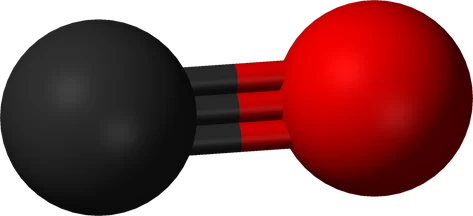
Molecule model: Wikimedia Commons, Carbon-monoxide-3D-balls.png (public domain).

This page is for information. For the substance on your site, the current safety data sheet (section 9) and the relevant standards apply. All substances are in the explosive limits table.
Frequently asked questions
What is the LEL of carbon monoxide in ppm?
10.9 % by volume, that is 109,000 ppm. 10 %LEL corresponds to 10,900 ppm and 20 %LEL to 21,800 ppm.
Is carbon monoxide heavier than air?
No, slightly lighter. Relative density 0.97 (air = 1): a release tends to rise but mixes readily with air movement.
Which Ex equipment is suitable for carbon monoxide?
Temperature class: any class from T1 to T6. Gas group: equipment marked IIA, IIB or IIC. The protection level (EPL) depends on the zone decided in the explosion protection document, not on the substance.
What is the autoignition temperature of carbon monoxide?
605 °C. A mixture touching a surface at this temperature can ignite without a flame or spark, so the surface temperature of equipment must stay below it (at least T1).